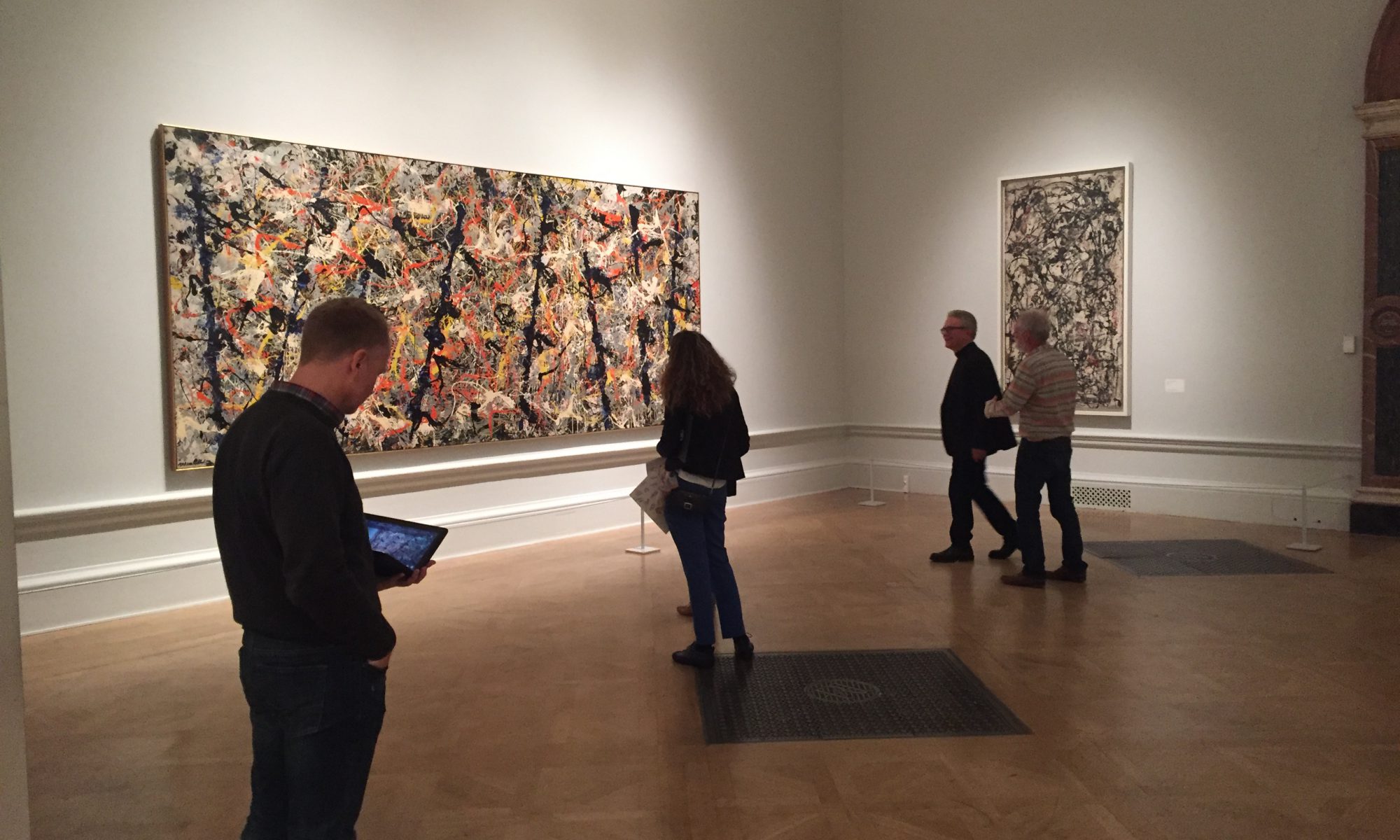
When Buswell (1935) and Yarbus (1967) developed methods to record human eye movements, they started to study fixation patterns on paintings, leading to a continuous research program on aspects of perceptual and cognitive processes as part of experimental aesthetics (Fechner 1876, Berlyne 1971). Due to technical limitations, our knowledge about eye movements on paintings has been restricted to observers looking from a fixed position at reproductions of art works under laboratory conditions. Although laboratory experiments are well controlled, they are far from the experience of a visitor in a gallery interacting with an original painting. The advance of mobile eye tracking (Land 1992, Durant & Zanker 2012) offers new insights to study gaze patterns on paintings in their real-world context. We used a TobiiGlasses2 system in an exhibition of Jackson Pollock paintings – known for their high complexity (Taylor 2002) – in Tate Liverpool (‘Blind Spot’, 2015), to collect an initial data set from observers walking freely through the gallery. These recordings reflect active interaction with the painting. Despite of challenges arising from large scale head movements, rapid changes of viewpoints and occlusions by other Gallery visitors, we found characteristic gaze patterns with preferred target regions, which would not be expected from the chaotic nature of this painting.

Gaze plot: one participant exploring Pollock’s ‘Summertime’ in Tate Liverpool
These promising initial results from a radically novel approach in experimental aesthetics, were asking for a more thorough investigation, requiring an extended collaboration with Museums and visitors of Art Galleries. The 2016 exhibition ‘Abstract Expressionism’ at the Royal Academy (London) offered a unique opportunity to study how individuals interact with large scale paintings created by Pollock in different stages of developing his characteristic drip-painting style. In an inspiring collaboration between the Royal Academy, supported by lenders from the US and Australia, and Royal Holloway University of London, and Acuity Intelligence Ltd., we recruited volunteer participants for eye tracking during a dedicated viewing period of the exhibition. This cooperation was the seed of a novel line research that connects sciences and arts, and can prompt fundamental changes in our understanding of how spectators look at and interact with artwork, and construct their aesthetic experience.